
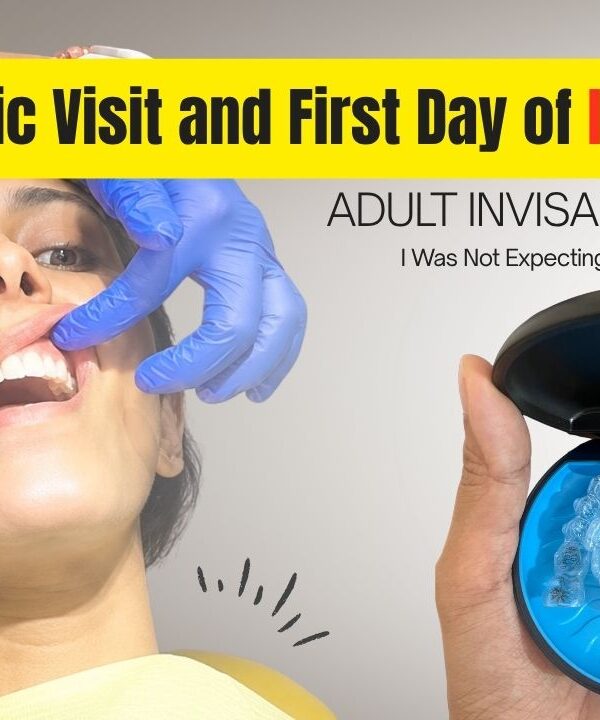
Okay, so this is officially the first post in what I’m calling my Invisalign journey series — and I want to start from the very beginning, before I even had aligners in my hand, because I know that’s the part nobody really talks about.
When my dentist first brought up straightening my teeth, I had three options on the table: metal braces, ceramic braces, and Invisalign. I’ll be honest, I went in assuming I’d end up with regular braces, mostly because that’s what everyone talks about. But my dentist actually recommended Invisalign for my specific case, and once she explained why, it made a lot of sense.

Why My Dentist Recommended Invisalign Over Braces
My teeth are crowded, but not severely — more moderate crowding than anything drastic. My dentist explained that Invisalign puts less overall pressure on the teeth compared to braces, and that it can move teeth one at a time in a more controlled, gradual sequence. For my level of crowding specifically, she felt that approach would work well without needing the more aggressive force that traditional braces apply. She estimated my full treatment would take somewhere between one year and a year and a half, depending on how consistently I wear my aligners and how my teeth respond along the way.
The One Thing That Almost Stopped Me: Cost
I’m not going to pretend cost wasn’t a real factor, because it absolutely was. Invisalign is genuinely expensive compared to traditional braces — in my case, nearly double the price. That’s not a small difference, and I sat with that decision for a while before committing.
What ultimately convinced me was weighing the pros and cons honestly rather than just defaulting to the cheaper option. Invisalign being removable, nearly invisible, and gentler on my teeth mattered enough to me that I decided the extra cost was worth it for my specific situation. I’d genuinely encourage anyone weighing the same decision to sit down and actually list out what matters most to you — comfort, appearance, budget, treatment time — rather than assuming one option is automatically “better” for everyone. It really does depend on your case and your priorities.
Before Invisalign: Getting My Teeth Professionally Cleaned First
Something I didn’t expect going in — before any aligner talk even started, I needed a professional cleaning. Turns out I had a fair amount of tartar buildup, and that needed to be dealt with first. This is actually a really important point I want to highlight: regular professional cleaning matters, and it becomes even more important right before starting orthodontic treatment, since you want your teeth and gums in the healthiest possible state before you start moving them.
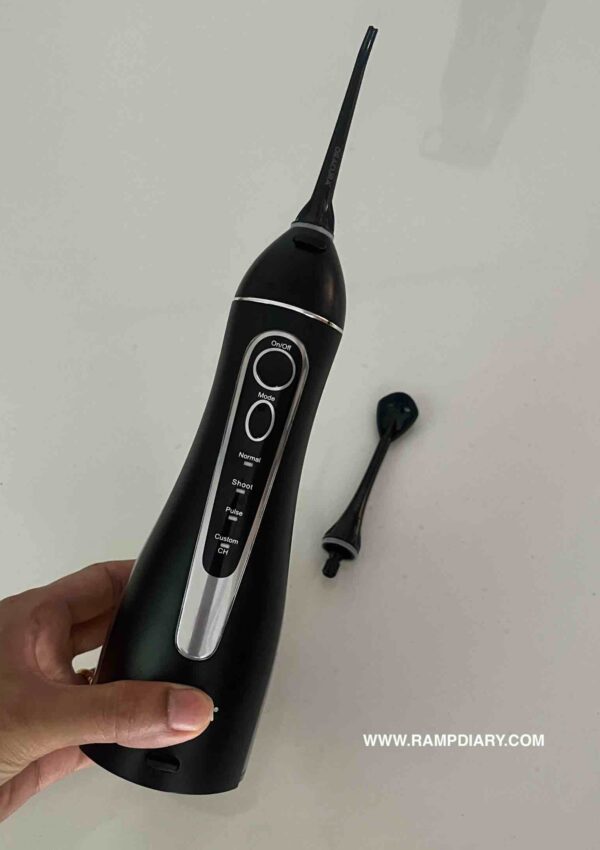
If you’ve read my post on fluoride toothpaste, this is exactly the kind of moment where a solid daily routine pays off — you’re about to spend a year or more with aligners in your mouth most of the day, so starting from a clean, healthy baseline genuinely matters. Also, do check out my water flosser article, water flosser was highly recommended by the dentist before starting my Invisalign treatment.
The Wait: What Happens After You Say Yes to Invisalign
Here’s something I wish someone had told me clearly beforehand: you don’t just walk out with your aligners the same day. My dentist placed the order for my custom aligner sets, and now I’m waiting for them to arrive — which is expected to take about a month. Once they arrive, I’ll get a call from my dentist’s office to come in and officially start treatment.
If you’re at this exact stage right now, waiting for that call, I get it — it’s a strange mix of excitement and impatience. But it makes sense once you understand that every set is custom-made specifically for how your teeth need to move, in the exact sequence your treatment plan maps out. It’s not an off-the-shelf product.
How Many Aligner Trays Will You Actually Need?
This was one of my first questions, and the answer is: it completely depends on your case. According to my dentist, the total number of sets can range widely — some people need around 20, others need 40 to 45 or more, depending on how much movement your teeth need and how complex your case is. There’s no universal number, so if you’re comparing your case to a friend’s or something you read online, don’t be surprised if the numbers look completely different.
For me specifically, here’s the schedule my dentist laid out:
- New aligner set every 2 weeks — I’ll switch to the next tray in the sequence every two weeks, assuming everything is tracking as expected.
- Dentist visit every 4 weeks — check-ins happen roughly once a month to make sure my teeth are moving the way the treatment plan predicted.
- Each appointment takes about 15 to 20 minutes — which honestly surprised me. I expected something longer, but it’s really just a quick progress check.
Attachments: The Small Tooth-Colored Bumps Nobody Warns You About
One detail my dentist mentioned that I hadn’t heard before starting all this research: she’ll be placing small tooth-colored attachments on some of my back teeth. These act almost like tiny anchor points — they give the aligner tray something to grip onto, which helps it stay securely in place and reduces the chances of it slipping or falling out during the day. They’re bonded onto the tooth and are barely noticeable, especially on back teeth where they’re not very visible in the first place.

After Treatment: Why Retainers Matter Just as Much as the Aligners
This is a part I think people underestimate before starting. Once the active aligner treatment is done, it’s not just “done, done.” My dentist explained that retainers will be placed along my upper and lower front teeth afterward, specifically to keep my teeth from drifting back toward their original positions. All that time and money spent moving your teeth into place can genuinely be undone if you skip the retainer phase, so it’s not an optional extra step — it’s really part of the full treatment, not an afterthought tacked onto the end.
Why Invisalign Felt Right for Me
At the end of all this research and decision-making, the biggest deciding factor for me was simple: Invisalign is transparent. People genuinely can’t tell you’re wearing anything unless they look really closely. For someone who was already a little self-conscious about the idea of a mouth full of visible metal for over a year, that mattered more than I expected going in. Being able to go through this entire process without feeling like everyone’s staring at my teeth made the decision feel a lot easier, even with the higher cost.
What I’m Taking Into This Journey
I’m documenting this whole process as I go — the good, the uncomfortable, the small wins — because I know I would have wanted to read something like this before I started, instead of only finding clinical, generic explanations. If you’re currently deciding between braces and Invisalign, or you’re already mid-process waiting for your own aligners to arrive like I am right now, I hope this gave you a clearer, more honest picture of what the beginning actually looks like.
Once my aligners actually arrive and treatment starts for real, I’ll be sharing the next part of this journey — including how the first set actually feels, what changes day to day, and whether it matches everything I’ve read about the adjustment period.
Frequently Asked Questions
Is Invisalign really better than braces for crowded teeth? It depends on the severity of the crowding. For mild to moderate crowding, many dentists consider Invisalign a strong option since it applies more gradual, controlled pressure. Severe crowding or complex bite issues may still be better suited to traditional braces — it really comes down to an individual dentist’s assessment of your specific case.
How long does Invisalign treatment usually take? Most patients complete treatment somewhere between 6 and 18 months, though mild cases can finish sooner and more complex cases can take up to two years. My own dentist estimated one year to a year and a half for my case.
Why does it take so long to receive the first set of aligners? Every aligner set is custom-manufactured based on your specific treatment plan and digital scans, so there’s a production and shipping lead time — commonly around three to five weeks from when the order is placed.
Do all Invisalign patients need attachments? Not everyone does, but many patients do, particularly when certain teeth need more complex movements like rotation. They’re small, tooth-colored, and bonded directly onto the tooth to help the aligner tray grip more securely.
Is it normal for Invisalign to cost more than braces? Yes, Invisalign is generally more expensive than traditional braces, sometimes significantly so depending on your case and provider. Many patients decide it’s worth the extra cost for the removability and near-invisibility, but it’s a genuinely personal decision worth weighing carefully.
Do I really need to wear retainers after Invisalign is done? Yes. Skipping retainers after treatment is one of the most common reasons teeth gradually shift back toward their original position. Retainers are considered a core part of the overall treatment, not an optional add-on.
Related Reads



It’s interesting what you’ve shared about Invisalign dental aligners; compared to other options that are cheaper but also more noticeable—and perhaps even more painful—I think it’s a good choice.